Overview
As part of this project, we also explored how AI can help with formatting resumes through LaTex. While many students build resumes using Microsoft Word or Google Docs, LaTeX offers a more structured way to create clean and professional documents.
The goal of this stage was to see whether AI could make LaTeX more accessible and whether using LaTeX actually improves the presentation of a resume.
What is LaTeX?
LaTeX is a document preparation system that uses code to format text instead of a traditional visual editor.
In a tool like Word, users manually adjust spacing, font size, and layout. In a LaTeX, users define the structure of the document through code, and the final PDF is generated from that structure.
This makes LaTeX useful for creating clean, consistent, and professional-looking documents such as resumes, reports, and academic papers.
Why We Explored It
Our project focused on AI-assisted resume development and digital portfolios, so LaTeX was a useful extension of that inquiry. If AI can improve resume content, then it also makes sense to ask whether AI can help with formatting and structure.
This made LaTeX a good skill-development component for the project.
How We Used It
To explore this, we asked AI tools to convert an existing resume into a clean LaTeX format that could be used in Overleaf. The prompts focused on keeping the content accurate, using a professional structure, and avoiding overly complex formatting.
After generating the LaTeX code, we tested it in Overleaf and made small edits where necessary.
Example Prompts:
Convert this resume into a clean and professional LaTeX format suitable for Overleaf. Keep it simple, readable, and ATS-friendly.
Improve the formatting of this LaTeX resume to make it more professional while keeping it clean and easy to read.
Comparison of AI Outputs
After generating LaTeX versions of the same resume using different AI tools, we noticed clear differences in both formatting and wording.
The ChatGPT version was cleaner and more spaced out, making it easier to scan. The Gemini version appeared more compact and polished, but also used more technical and strategic wording.
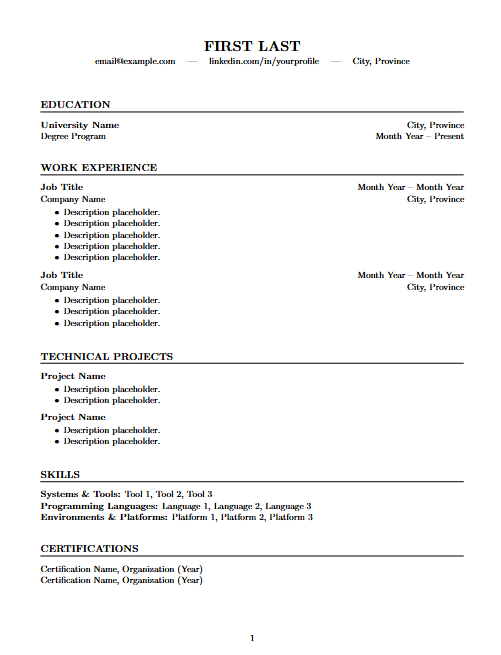
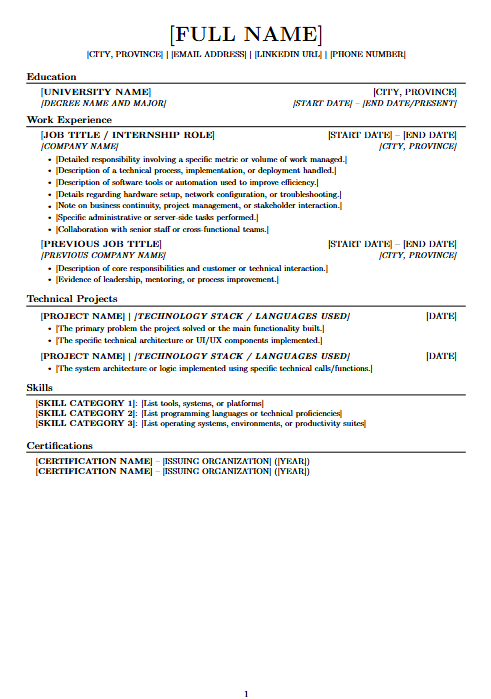
| Feature | ChatGPT | Gemini |
| Layout | Cleaned and spaced out | More Compact |
| Tone | Simpler and more natural | More technical and polished |
| Readability | Easy to scan | More dense |
| Authenticity | Closer to original wording | More enhanced wording |
Role of AI in the Process
AI made the process much easier than starting from scratch.
Instead of learning LaTeX syntax independently and building a resume line by line, we were able to generate a workable starting point and then refine it.
This was especially helpful for section structuring, bullet point formatting, spacing, and layout consistency.
However, AI did not produce a perfect final version immediately, with some outputs requiring manual cleanup, small fixes, or formatting changes.
This reinforced an important idea from the project: (can delete this if cringe)
AI is most useful as a starting point and support tool, not a complete replacement for user input.
Advantages of Using LaTeX
Through this process, several benefits became clear.
- LaTeX made the resume look more structured and professional. Once the code was set up properly, formatting stayed consistent across the entire document.
- Compared to more basic document editors, LaTeX made it easier to create a polished layout without relying on visual guesswork.
- Once a LaTeX resume template is created, it can be edited and reused for future applications.
- Because LaTeX is commonly associated with academic and technical work, it can feel especially relevant for students in Computer Science and related fields.
Limitations of Using LaTeX
At the same time, LaTeX also had some clear limitations.
- It was less intuitive than Word or Google Docs, as even small edits could feel more difficult at first because they required changes to code rather than direct visual editing.
- If someone wants to make very quick edits, LaTeX can feel slower than a normal document editor.
- Although AI generated most of the structure, the result still needed to be checked carefully. Formatting issues and content changes still required human review.
Connection to Industry Insights
(not sure if this should be included to emphasize relevance of LaTeX)
One of the most important insights from our discussion with an industry professional was that authenticity, fit, and genuine interest matter more than how polished a resume looks.
This made us reflect on the actual value of LaTeX. While it can improve the presentation and make a resume look more professional, formatting alone does not make a candidate stronger.
A clean layout can support communication, but it cannot replace real experience, genuine interest, and strong alignment with the role.
This was an important reminder that presentation matters, but it is secondary to content.
Key Takeaway
This part of the project showed that LaTeX can be a useful tool, especially when combined with AI. It allows students to create structured and professional-looking resumes without starting entirely from scratch.
At the same time, it also showed that better formatting does not automatically mean better substance. AI and LaTeX can improve presentation, but they must still be used carefully so that the final resume remains accurate and authentic.
Inquiry Process
This section builds on our earlier inquiry posts, where we documented our experiments with AI tools, resume optimization, and formatting approaches.
- Aiden’s Inquiry Post on []
- Anthony’s Inquiry Post on Using AI and LaTeX to Build and Evaluate a Resume